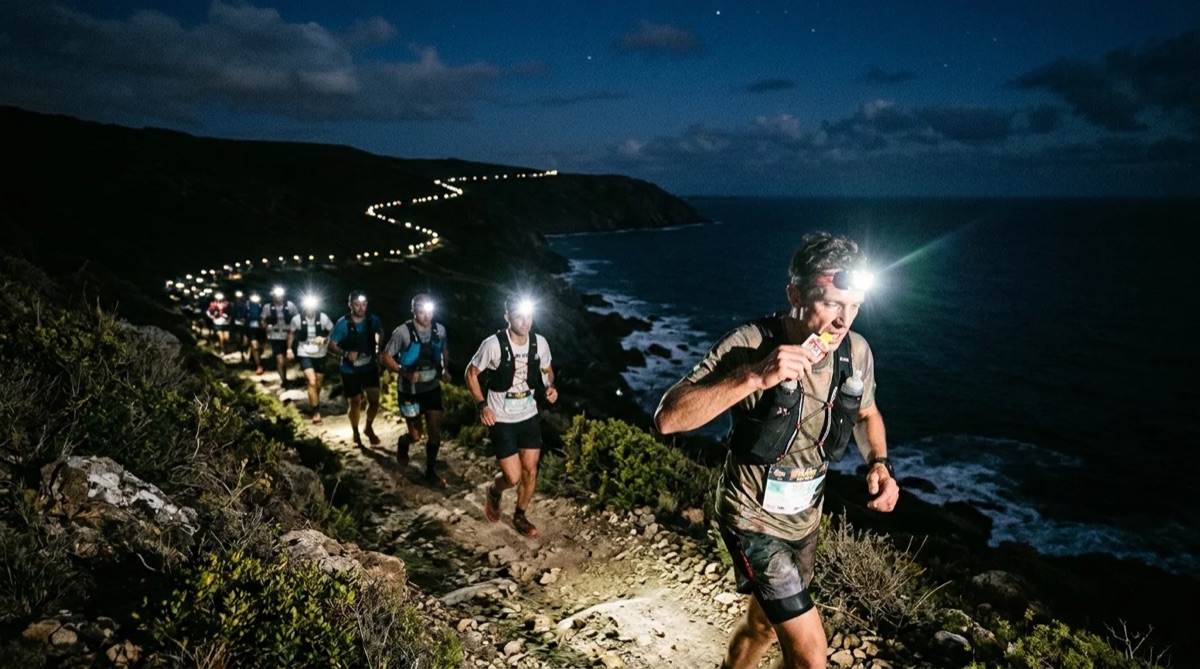
Long Trail and Ultra Nutrition: Race Week, the Day Before, and Fueling for 4+ Hours
An effort over 4 hours is also won at the table: race week meal by meal, race day for a night start, then 60 to 90 g of carbs per hour with salty food. The plan, with sources.
On a trail race of more than 4 hours, nutrition is no longer a detail. It's a discipline of its own, and it's often nutrition, more than your legs, that decides whether you drop out. The good news: you can prepare it like everything else.
Race week, meal by meal
Day -7 to day -3: normal, and enough. Your plan gets lighter, but you don't go on a diet. Carbs at every meal (bread, rice, pasta, potatoes), a protein, vegetables. It's also the week to do your last shopping: gels, drink mix, bars, everything you've already tested on long runs.
Day -2 and day -1: carb loading. 10 to 12 g of carbohydrate per kilo per day for the 36 to 48 hours before the start (Thomas, Erdman and Burke, 2016). For 65 kg, 650 to 780 g per day. Low fiber, low fat. The sample day and recipes are in our article on carb loading. With the lighter training of race week, 24 hours is even enough to fill your muscles to the max (Bussau et al., 2002): two days give you some margin.
Race day, morning start. Breakfast 3 to 4 hours before, 2 to 4 g of carbs per kilo. Ideas are in our article on race day breakfast.
Race day for a night start
A 10 pm start changes everything: you have a whole day to manage.
| When | What you eat |
|---|---|
| Morning | Your usual breakfast, rich in carbs. Sleep in if you can. |
| Noon | The big meal of the day: pasta, rice or potatoes, a protein, low fiber. |
| 4 pm | A snack: bread, jam, applesauce, rice pudding. |
| 3 to 4 h before the start | The last real meal, light and familiar: rice, semolina or pasta, a little ham or chicken. |
| 1 h before | A banana, an applesauce pouch or a sweet drink. |
The principle is the same as for a morning start: last meal 3 to 4 hours before, nothing new. And plan an afternoon nap; it will be your best ally during the night.
During the race: 60 to 90 g per hour
For efforts longer than 2.5 hours, the recommendations go up to 90 g of carbs per hour (Burke et al., 2011), with a mix of glucose and fructose so they get absorbed (Jeukendrup, 2014). Jeukendrup notes that the target can come down when intensity is low: on an ultra where you hike part of the time, 60 g per hour is already a good goal.
For 65 kg, a 6 hour race: 650 to 780 g of carbs per day for the 2 days before, then 360 to 540 g during.
Four rules from the field:
- Eat from the first hour, small and often, every 20 to 30 minutes. Once you've hit the slump, it's too late to catch up.
- Alternate sweet and salty. After three hours of gels, nausea is lurking. At the aid stations: salty soup, potatoes, mashed potatoes, crackers, cheese, bread. They're carbs too.
- Salt matters. Over hours of effort, especially in the heat, a salty drink or salty food replaces the sodium you lose in sweat.
- Drink to thirst, without forcing it: no more than 2% of your body weight lost, and no weight gained (ACSM, 2007).

Most important of all: your gut can be trained
Gut problems are common in endurance racing, and the longer the race, the bigger the toll. But your stomach and gut adapt: emptying, comfort and absorption improve with practice (Jeukendrup, 2017). In practice:
- Every long run is a fueling rehearsal: same products, same rate as on race day.
- Build up gradually: 40 g per hour, then 60, then more if you're aiming high.
- Test salty food: soup in a thermos, potatoes in a bag.
- If you're racing at night, do at least one long run in the evening, after the meal you plan to eat.
Summary
- Day -7 to day -3: eat normally, carbs at every meal, do your shopping.
- Day -2 and day -1: 10 to 12 g of carbs per kg per day (Thomas, Erdman and Burke, 2016).
- Race day: last meal 3 to 4 hours before the start, even at night.
- During: 60 to 90 g per hour depending on intensity (Burke et al., 2011; Jeukendrup, 2014), sweet and salty.
- Above all: test on long runs, your gut can be trained (Jeukendrup, 2017).
AI running coach
Ready to run with a coach who gets you?
ISAA analyzes your data and coaches you at your own pace, without judgment.
Free · No commitment