Running Gels and Fueling: How Many Carbs per Hour During a Race?
Nothing under 1 hour, 30 to 60 g per hour up to 2.5 hours, up to 90 g beyond. How many gels, when to take them, and how much to drink, based on Burke and Jeukendrup.
You can carb load perfectly and eat the ideal breakfast: in a long race, the tank eventually runs dry. What you take in during the effort decides whether you hold your pace to the finish. And how much you need depends first of all on how long your race lasts.
How many carbs per hour?
The recommendations from Burke, Hawley, Wong and Jeukendrup (Burke et al., 2011) and from Jeukendrup (Jeukendrup, 2014) are organized by duration:
| How long your race lasts | Carbs during the effort |
|---|---|
| Under 1 h (5K, 10K) | Nothing. Water if you're thirsty. |
| About 1 h | A little, or even just a mouth rinse with a sports drink |
| 1 h to 2.5 h (half marathon, fast marathon) | 30 to 60 g per hour |
| Over 2.5 h (marathon, trail) | Up to 90 g per hour |
Beyond 60 g per hour, you need a mix of glucose and fructose: a single sugar can't be absorbed faster than about 60 g per hour, and the rest piles up in your gut (Jeukendrup, 2014). Most "2:1" or "glucose fructose" gels are designed for exactly that. Read the label.
What that means in gels
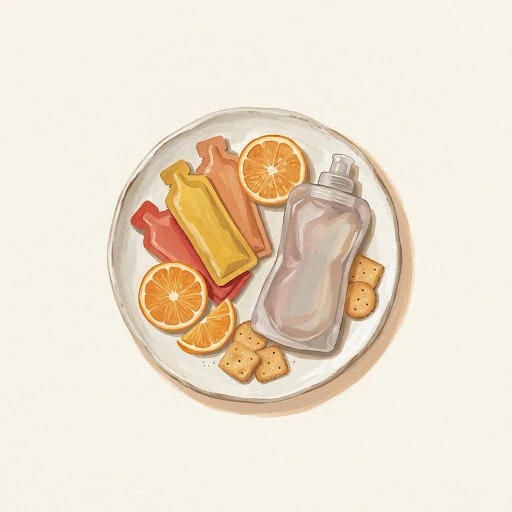
A gel usually delivers 20 to 30 g of carbs (again, read the label: some contain 40). Half a liter of sports drink, about 30 g.
Real example, a 4 hour marathon: at 60 g per hour, you need about 240 g, so 8 to 10 gels, or gels plus drink at the aid stations. First intake after 30 to 45 minutes, then every 20 to 30 minutes, without waiting until you're hungry or start to fade. By the time you feel the fatigue, it's already late.
A 1:50 half marathon: 30 to 60 g per hour, so 2 or 3 gels, for example at kilometer 7 and kilometer 14.
A 4 hour marathon: 240 g, so 8 to 10 gels. A 1:50 half marathon: 2 or 3 gels.
Your gut can be trained
90 g per hour isn't something you improvise on race day. Gut problems are common in endurance racing, and the good news is that they can be trained away: stomach emptying, comfort and carb absorption adapt to what you regularly ask of them (Jeukendrup, 2017).
In practice, in the weeks before the race:
- Test your gels on long runs, the exact brand and flavor you'll use.
- Build up gradually: 30 g per hour, then 45, then 60.
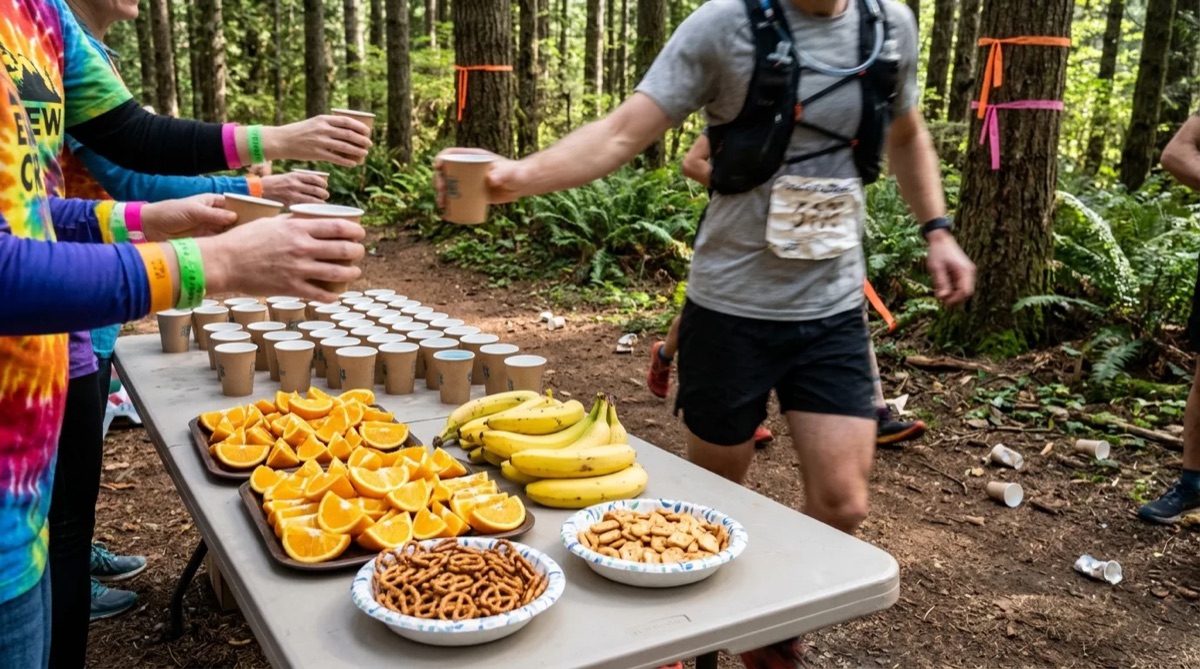
- Check what the organizers hand out at the aid stations (it's on the race website). If you plan to rely on their drink, test the same one.
What about water?
Drink to thirst, no more, no less. The ACSM position stand on hydration (American College of Sports Medicine, 2007) sets two limits: avoid losing more than 2% of your body weight in water, and avoid drinking so much that you gain weight. Drinking too much can make your blood sodium drop, and that's dangerous.
To find out what you need, weigh yourself before and after a long run without drinking during it: one kilo lost is about one liter of sweat. In hot weather or over several hours, a drink that contains salt (sodium) helps make up for it.
Summary
- Under 1 hour: nothing to eat.
- 1 to 2.5 hours: 30 to 60 g of carbs per hour (Burke et al., 2011).
- Over 2.5 hours: up to 90 g per hour, with glucose and fructose (Jeukendrup, 2014).
- Every 20 to 30 minutes, starting in the first half hour, without waiting until you're hungry.
- Test everything on long runs first, your gut can be trained (Jeukendrup, 2017).
- Drink to thirst: no more than 2% of body weight lost, and no weight gained (ACSM, 2007).
AI running coach
Ready to run with a coach who gets you?
ISAA analyzes your data and coaches you at your own pace, without judgment.
Free · No commitment