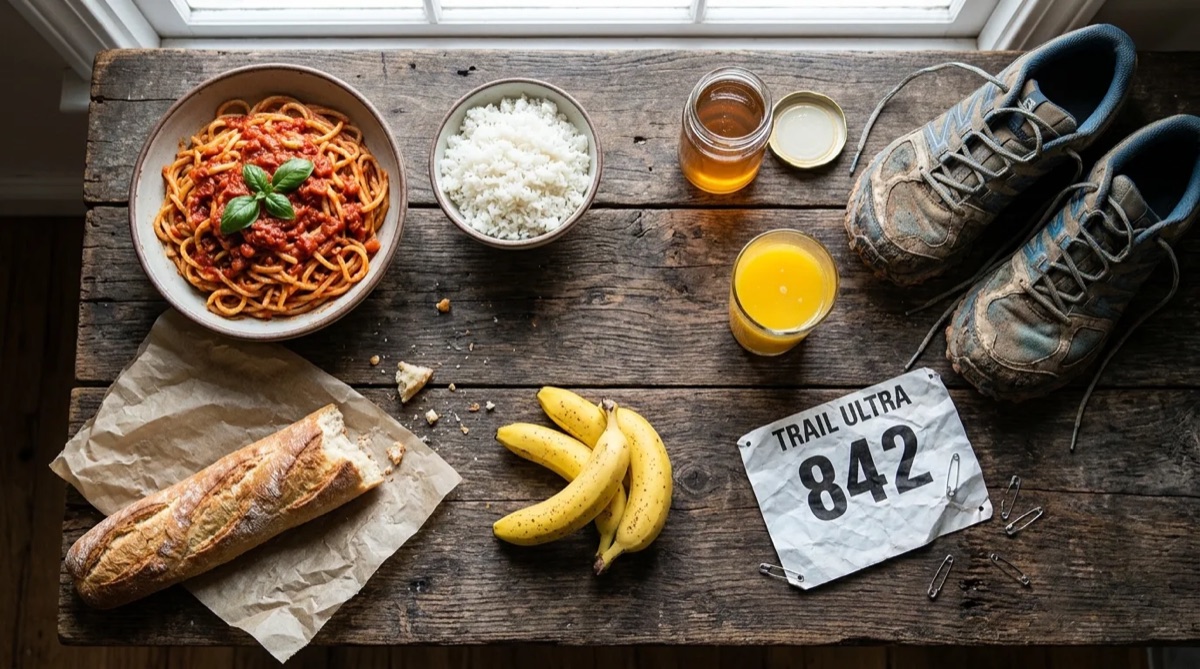
Carb Loading Before a Half Marathon, Marathon or Trail Race: How Much, When, and What to Eat
Carb loading in the 36 to 48 hours before a race: 10 to 12 g per kg per day, who it actually helps, a sample day with the grams, and five simple recipes.
Three days before your race, the question always comes up: "should I be eating pasta?" The short answer: yes, if your race lasts more than an hour and a half. And a lot more than you think. Here are the numbers, what they look like on a plate, and what to avoid.
What is carb loading for?
Your muscles store fuel as glycogen. For a short effort, that store is more than enough. For a long one, it runs out, and that's the famous "wall" around kilometer 30: your legs stop responding and your pace collapses.
Carb loading fills that tank to the brim before the start. A review by Hawley and colleagues (Hawley et al., 1997) put numbers on it: for efforts longer than 90 minutes, a full tank delays fatigue by about 20% and improves performance over a set distance by 2 to 3%. In a 4 hour marathon, 2% is close to 5 minutes.
The same review is just as clear about the flip side: for an effort of 60 to 90 minutes, there is no benefit. For a 5K or a 10K, carb loading does nothing except make you feel heavy. We cover that in our article on the night before a 5K or 10K.
How much and when?
The joint position statement of the ACSM and the American and Canadian dietitians (Thomas, Erdman and Burke, 2016) recommends 10 to 12 g of carbohydrate per kilo of body weight per day, for the 36 to 48 hours before an effort longer than 90 minutes.
In practice, for a Sunday race, carb loading starts on Friday morning.
| Your weight | Carbs per day |
|---|---|
| 55 kg | 550 to 660 g |
| 65 kg | 650 to 780 g |
| 75 kg | 750 to 900 g |
| 85 kg | 850 to 1,020 g |
That's a lot. Far more than one plate of pasta on Saturday night. That's why most runners who think they've carb loaded actually haven't.
No need to deplete first
Old protocols started by draining your stores with several low carb days and a hard workout. That's no longer necessary. Bussau and colleagues (Bussau et al., 2002) showed in trained athletes that with 10 g/kg per day and rest, muscle glycogen reaches its maximum within 24 hours. In race week your plan is already lighter: those are exactly the conditions you need.
A sample day at 640 g of carbs
For a 60 kg runner, about 10.5 g/kg. The amounts are guidelines, not a reason to weigh everything to the gram.
| Meal | What you eat | Carbs |
|---|---|---|
| Breakfast | 80 g of rolled oats cooked in 250 ml of milk, 1 banana, 1 tablespoon of honey, 1 glass of orange juice | ≈ 125 g |
| Mid morning | 60 g of white bread or baguette, 30 g of jam | ≈ 50 g |
| Lunch | 150 g of white rice (dry weight), chicken, peeled zucchini, 50 g of bread, 1 applesauce cup | ≈ 165 g |
| Afternoon snack | 1 rice pudding, 1 banana, 500 ml of diluted fruit cordial or sports drink | ≈ 105 g |
| Dinner | 150 g of pasta (dry weight) with tomato sauce, parmesan, 50 g of bread, 1 applesauce cup | ≈ 165 g |
| Evening | 30 g of raisins or 2 rice cakes with honey | ≈ 30 g |
Sweet drinks, juices and cordials are your friends: they deliver carbs without filling your stomach. For a different weight, the calculator does the math:
For a different weight, scale the portions: × 1.25 at 75 kg, × 0.9 at 55 kg.
What to avoid during those two days
- Fiber: whole grain bread, beans and lentils, lots of raw vegetables, fruit with the skin on. Fiber fills your stomach and can upset it on race day. Go for white bread, white rice, regular pasta, cooked and peeled vegetables.
- Too much fat: it takes the place of carbs and digests slowly. Tomato sauce rather than cream, nothing fried.
- Anything new: no exotic restaurant, no food you've never eaten before.
- Alcohol.
The scale goes up, and that's normal
Every gram of glycogen is stored with water. You can gain 1 to 2 kg while carb loading. That's not fat, it's the fuel and water you'll use during the race. It's actually a sign the loading worked.
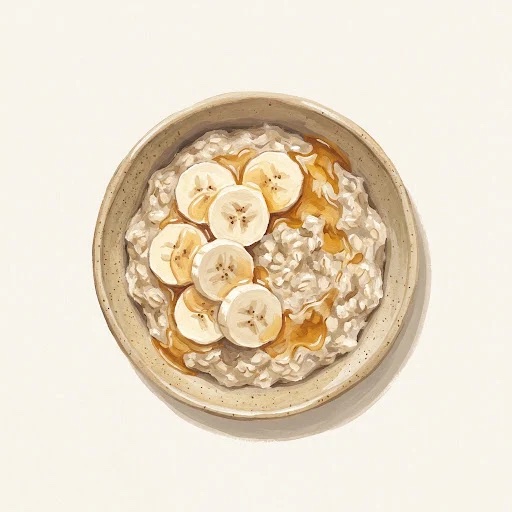
Five easy recipes to hit the target




What about race morning?
Carb loading fills the tank. Race day breakfast tops it off: see our article on race day breakfast. And during the race, you'll need to keep taking in carbs: that's our article on gels and fueling.
Summary
- Who it's for: efforts longer than 90 minutes. Not a 5K or a 10K.
- How much: 10 to 12 g of carbs per kg per day (Thomas, Erdman and Burke, 2016).
- When: the 36 to 48 hours before the start. No depletion phase needed (Bussau et al., 2002).
- How: white bread, rice, pasta, juice, cordials, applesauce. Low fiber, low fat, nothing new.
- The payoff: up to 20% later fatigue and 2 to 3% better performance (Hawley et al., 1997).
AI running coach
Ready to run with a coach who gets you?
ISAA analyzes your data and coaches you at your own pace, without judgment.
Free · No commitment