Effort km & Elevation Gain: Pick Your First Trail Race
Effort km, elevation gain, ITRA categories from XXS to XXL: what a trail race is really worth, how to pick your first one and train for hills without mountains.
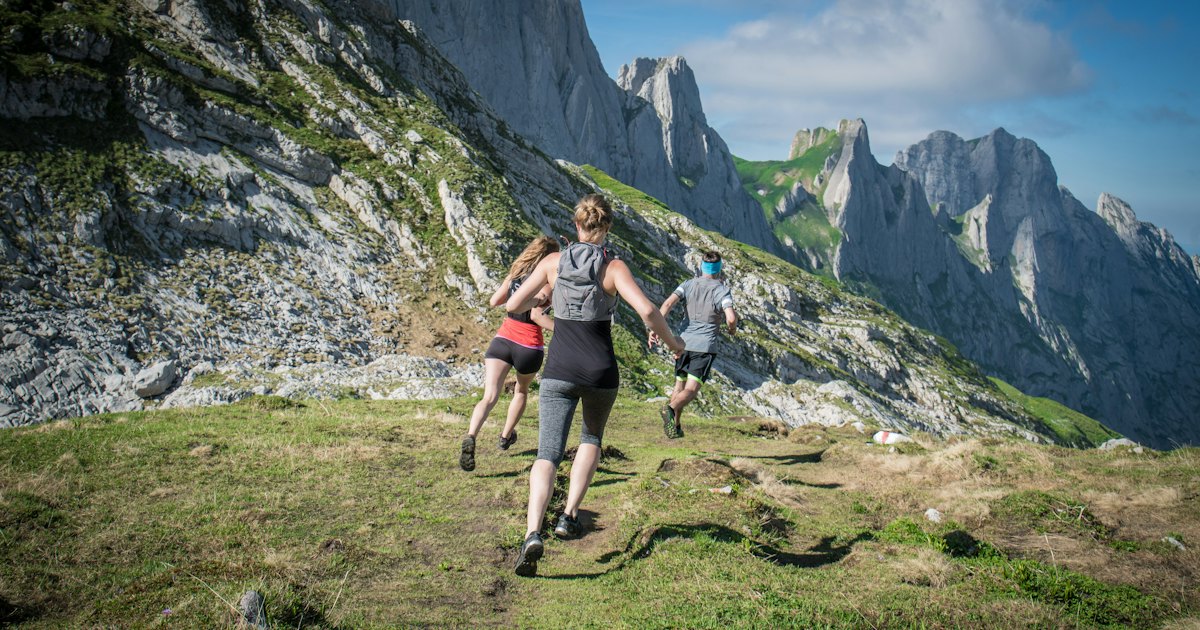
You run a road half marathon in 1:50. You spot a 20 km trail race and think: "20 km is shorter than a half, no problem." Then you read the small print under the distance: 1,000 m of elevation gain. And suddenly nobody knows how long it's going to take.
That's normal. In trail running, distance alone tells you almost nothing: what counts is how much work the course asks of you. To measure it, trail runners use a simple tool, the effort km (also called km-effort). Here's how it works, how to use it to choose your first trail race, and how to train for climbing even if you live somewhere flat.
What is effort km in trail running?
Effort km is the distance plus the elevation gain converted into kilometers. The formula used by ITRA (the International Trail Running Association) is: effort km = distance in km + elevation gain in meters divided by 100 (ITRA, Race Score).
In other words, 100 m of climbing counts as 1 km of flat. It's a convention, not a law of physiology: it says nothing about technical terrain, altitude or heat. But it gives you a common scale to compare two courses that have nothing in common.
Example: a 30 km trail with 1,500 m of elevation gain is worth 30 + 15 = 45 effort km.
Why 20 km of trail isn't 20 km of road
Go back to your 20 km trail with 1,000 m of elevation gain. In effort km, it's worth 20 + 10 = 30 effort km. Your road half marathon is worth 21.1 effort km: no climbing, nothing to add. On paper, your "short" trail race asks about 40% more work than your half.
And it's not just bookkeeping. Climbing is expensive. Minetti and colleagues measured the energy cost of treadmill running at different gradients: 3.4 J per kg per meter on the flat, versus 18.9 J/kg/m at a 45% gradient, more than five times as much (Minetti 2002). Even downhill isn't free: the cost of running drops down to about a 20% downhill gradient, then rises again as the slope gets steeper (same study).
Add the terrain (rocks, roots, mud) and your road pace is useless for predicting your time. Effort km measures work, not a finish time.
What are the ITRA race categories, from XXS to XXL?
ITRA sorts races into seven categories based on their effort km (ITRA, Race Score):
| Category | Effort km |
|---|---|
| XXS | under 25 |
| XS | 25 to 44 |
| S | 45 to 74 |
| M | 75 to 114 |
| L | 115 to 154 |
| XL | 155 to 209 |
| XXL | 210 and over |
Example: a 65 km race with 3,500 m of elevation gain is 65 + 35 = 100 effort km, so an M. A 42 km race with 2,000 m of gain is 62 effort km: an S, even though it's marathon distance.
These categories describe the endurance required, not how technical the course is or how long it takes.
How to choose your first trail race
No study settles this. What follows is coaching convention, the kind we apply when preparing a road runner for a first trail race.
Start from what you can already run
The safest rule of thumb: pick a race whose effort km isn't much more than the longest distance you've run recently on the road. If you already run 10K comfortably, a 15 km trail with 400 m of elevation gain (19 effort km, XXS category) is a great first goal. If you have a half marathon in your legs, an XS around 30 effort km is reasonable.
Think in time, not distance
On a trail, you'll walk, stop at aid stations, slow down on technical sections. A 20 km race with 1,000 m of gain can take you 3 hours where your half takes under 2. That time on your feet is what you need to train for. This number is a coach's ballpark, not a prediction: the only real way to know is to run hilly long runs and check your watch.
Look at the profile, not just the total
One 800 m climb in a single push is nothing like twenty small bumps. And the last descent, on tired quads, is often where the race is won or lost.
How to train for elevation gain without mountains
You don't need to live in Chamonix: what counts is piling up climbing. The three tools below are coaching convention: no study says which one is best.
- Hill repeats. Find a climb of 1 to 3 minutes. Go up at a fast hike or a run, come back down easy, repeat. Example: 10 climbs of 50 m of gain is 500 m of elevation gain in your session, without leaving town.
- Stairs. A 10 story building is about 30 m. Ten climbs is 300 m of elevation gain. Perfect for practicing fast uphill hiking, hands pushing on your thighs, like on a real steep climb.
- Incline treadmill. Most treadmills go up to 15%. At that gradient, 30 minutes of fast walking at 5 km/h gets you about 370 m of climbing (2.5 km at 15%). It's the only tool that gives you a continuous climb when there isn't a hill anywhere near you.
Start with one session like this a week, then increase your total weekly elevation gain gradually.
Should you walk the hills in trail running?
Yes, and it's not a sign of weakness. On steep slopes, walking costs less energy than running.
Giovanelli and colleagues had fifteen runners climb at a fixed vertical speed (1,260 m per hour) on steeper and steeper slopes. From 15.8°, about a 28% gradient, walking cost less than running (Giovanelli 2016). The same team pushed it to 30°: at slow speeds, walking was 20.6% cheaper, and the gap narrowed as speed went up (Ortiz, Giovanelli and Kram 2017). Minetti had already found the same trend at a 45% gradient: 17.3 J/kg/m walking versus 18.9 running (Minetti 2002).
In practice: above about 15° (28%), walk. A power hike, hands pushing on your thighs, short steps. You save energy for the runnable sections. Between 10 and 15%, it depends on your level and the length of the race: the longer the race, the earlier it pays to walk. That last point is a runners' rule of thumb, not a lab result.
Why does downhill running destroy your quads?
On a descent, your quads brake your fall with every step. They work while lengthening under load: an eccentric contraction, the type that causes the most muscle damage and the soreness of the following days (Bontemps 2020).
Downhill running can be trained, and one session protects the next
Your body adapts quickly to this stress. It's called the repeated bout effect: after a first downhill session, the next one damages the muscle much less. In Byrnes' 1985 study, reported by Bontemps 2020, runners did 30 minutes of downhill running at a 10% gradient. Repeated 3 or 6 weeks later, the same session caused fewer markers of muscle damage and less soreness. With no downhill running in between, the protection had disappeared after 9 weeks.
In practice: don't discover downhill running on race day. Slip a downhill section into a run every two or three weeks, starting short and gentle. Bontemps stresses gradual progression: too much downhill at once, and you get injured instead of adapting.
Example: if your race finishes with 600 m of descent, schedule two or three runs in the last six weeks where you string together 10 to 20 minutes of continuous downhill at an easy effort.
Why train by heart rate instead of pace in trail running?
On the road, 5:30 per km is always roughly the same effort. On a trail, that same 5:30 is a stroll downhill and an impossible effort on a 15% climb. The review by Vernillo and colleagues shows how much the gradient changes your stride, how your muscles work and the energy cost of running (Vernillo 2017). With costs varying by a factor of five depending on the slope (Minetti 2002), a target pace no longer makes sense.
Heart rate, on the other hand, follows effort whatever the slope. And even on the flat, it works better: in a study of 37 amateur runners, a heart rate prescription kept them in the target zone 85% of the time during easy runs, versus 69% with a pace prescription (Ranieri et al. 2026). That study was on flat ground: on climbs, the gap can only grow, since pace loses all meaning there.
In practice: set your easy runs and long run in your aerobic heart rate zone, and let pace do whatever it wants. On a climb, your watch might show 9:00 per km. If your heart is in the right zone, you're doing exactly the right session. VDOT stays useful on the flat, much less in the mountains.
How to do a trail long run
On the road, long runs are measured in kilometers. In trail running, it's coaching convention to prescribe them in time, for the reason above: 15 km on a flat path and 15 km with 800 m of gain have nothing in common.
Example: instead of "18 km", your long run becomes "2 h 15 at an easy effort, with at least 500 m of elevation gain". The day you do it on steeper ground, you'll cover less distance, and that's perfect: time on your feet is what prepares you.
Use these runs to rehearse race day: walking the climbs, eating on the move, descending on tired legs. And build the duration without getting carried away: it's one of the classic beginner running mistakes.
Summary
- Effort km = km + elevation gain / 100. A 20 km race with 1,000 m of gain is worth 30 effort km, more than a half marathon.
- ITRA categories: XXS under 25, XS 25 to 44, S 45 to 74, M 75 to 114, L 115 to 154, XL 155 to 209, XXL 210 and over.
- First race: an effort km close to what you already run, and a plan built around time.
- You can train elevation gain on flat ground: hill repeats, stairs, incline treadmill.
- Walk the steep climbs: above about 15°, walking costs less than running.
- Train your downhills: one session protects your quads for several weeks, not forever.
- Train by heart rate, and count your long run in hours, not kilometers.
AI running coach
Ready to run with a coach who gets you?
ISAA analyzes your data and coaches you at your own pace, without judgment.
Free · No commitment